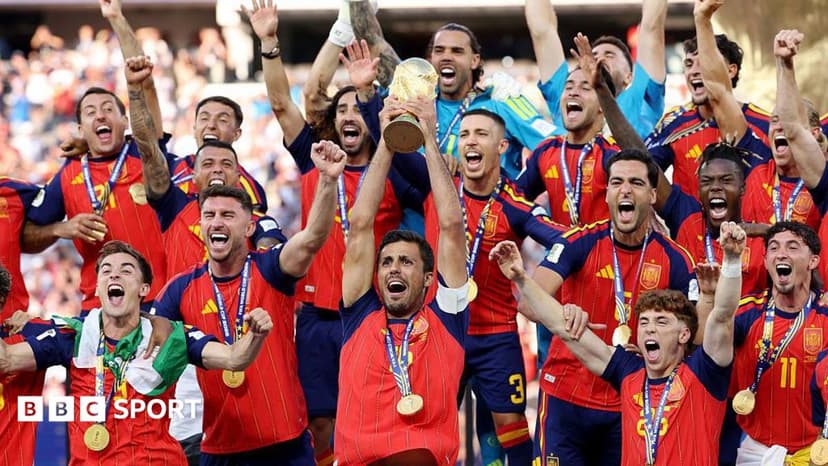
Nico Williams was one of the leading figures in unforgettable victory over Argentina in the final. The explosive Athletic Club winger, who has forged a close bond with team-mate , arrived at the tournament nursing an injury but still made his presence felt on the global stage. In the 106th minute of the final, Williams supplied with the opportunity from which he scored the only goal of the contest, securing the trophy for La Roja just as Andres Iniesta had done 16 years earlier in South Africa.
His older brother and Athletic team-mate Inaki congratulated him on social media for making history: “But aside from the trophy, thank you for what you’ve done,” he wrote. “You’ve made millions of immigrants like our parents proud, showing them that their children may one day experience what you have. You’ve also helped millions of Spaniards connect with our story – one shared by everyone who leaves everything behind in search of a better future.”
Their parents, Comfort and Felix, left Ghana and crossed the Sahara Desert on foot in search of a better life, overcoming countless difficulties along the way. Comfort was pregnant when they finally reached Europe, and Inaki was born at a hospital in Bilbao on 15 June 1994. His parents named him after Inaki Mardones, the priest who had met them at Bilbao train station two months earlier, found them temporary accommodation and later helped secure them a more permanent home. Mardones also took the couple to hospital by taxi on the day Inaki was born. He later baptised him and gave him his first Athletic Club shirts.
“From a young age, I knew what it was like not to have enough money to pay the utility bill or to have the water cut off,” Inaki told Spanish football magazine Panenka in an interview. “I could see the differences between me and the rest of my classmates or team-mates; the other children’s parents would pick them up from school or training. I often missed my parents when I was growing up,” he admitted. “But I could never hold it against them for not being there to make me a sandwich when they were working themselves to the bone to put food on the table and ensure we had water and clothes.”
The family moved from Bilbao to Sesma, a small town in the province of Navarre, where Felix worked on a pig farm, before later settling in Pamplona. Both brothers began playing football in Pamplona, where Nico was born on 12 July 2002; Inaki started out at Club Natacion Pamplona, while Nico joined Junta Deportiva San Jorge.
Nico was six when he first arrived at San Jorge’s ground, accompanied – as ever – by his brother. “I remember being told that a new boy was coming for a trial,” said Diego San Roman, Nico’s first coach. “He had only touched the ball a few times, but that was enough for us to realise there was something special about him. I stopped the training session and went over to speak to Inaki to tell him that, of course, his brother could stay.” Born in Pamplona in 1995, San Roman was only 13 at the time – a year younger than Inaki.
“Nico had incredible pace and acceleration,” he said. “He was physically outstanding and stood out for his power, speed and change of pace. He also struck the ball with tremendous power and was equally comfortable on either foot. Whatever he could do with his right, he could do with his left.”
San Roman also recalls Nico doing stepovers at just six or seven. Laughing, he admitted he found it amusing that Nico set up Spain’s World Cup-winning goal with a header, as heading had always been one of the weaker aspects of his game as a youngster.
“He was an incredibly humble and reserved boy,” his former coach added. “He always arrived with a smile and had impeccable manners. He never sulked or complained.” San Roman and Nico would often travel to matches together in the coach’s father’s car. Comfort was juggling several jobs and was rarely able to attend, while Felix had moved to London in search of work.
Luisma Marro, San Jorge’s current president, has been involved with the club for more than four decades. He remembers Nico as “a confident youngster who always wanted the ball”. “At that age, it’s impossible to know who’ll go on to reach the highest level,” said the Pamplona-born Marro. “But even then, you could see he had what it takes.”
After two years, Nico followed Inaki to Pamplona. He later joined Osasuna before moving to Bilbao in 2013. From there, he broke into the senior game and continued to develop into one of the world’s top wingers, becoming a European champion in 2024 before adding the world title in 2026.
“Nothing has been handed to them,” San Roman reiterated. “They have had to overcome so much in their lives. Nico always made me smile. Whenever he trained or played, the way he expressed himself on the pitch brought a smile to my face. Players like him are the reason I want to continue coaching.”
📸 Photo of Nico Williams with Junta Deportiva San Jorge courtesy of Junta Deportiva San Jorge
Sources: FIFA Official