The Match
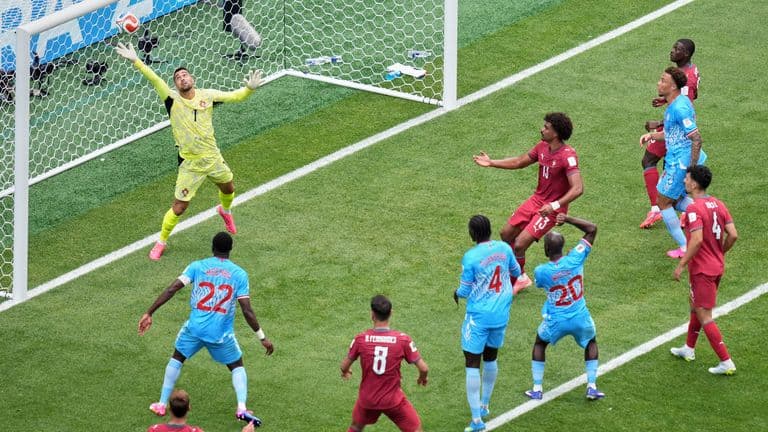
Football has always had a soft spot for the underdog, for the moment when the script is ripped up and something genuinely unexpected rewrites the story. At NRG Stadium in Houston on June 17, DR Congo provided one of those moments. Playing in their first-ever World Cup Finals match, the Leopards — who had qualified through a gruelling CAF qualifying campaign that captured the imagination of an entire continent — fell behind to João Neves' sixth-minute strike and spent the next twenty minutes apparently heading toward a defeat that was entirely in line with expectations. Then Yoane Wissa collected the ball on the edge of the box, assessed the situation with the composure of a striker who scores important goals every week in the Premier League, and drove the equaliser past Diogo Costa to write the Democratic Republic of Congo into World Cup history.
It was the first goal, and the first point, DR Congo had ever achieved at the World Cup Finals. A nation of 100 million people — the most populous French-speaking country in the world — celebrated simultaneously. In the stadium, the Congolese supporters section was a mass of blue and red, noise and emotion. On the pitch, Wissa sprinted to the corner flag and the entire team followed him in a celebration that spoke to what the moment meant. The second half saw Portugal dominate the ball and press for a winner they never found. DR Congo defended with remarkable discipline — the back five compact, organised, and refusing to be broken down despite the relentless Portuguese attacking. The 1-1 final score is, by any measure, one of the results of this World Cup's opening round.
Standout Performers
Yoane Wissa was the man of the match without serious challenge. His equaliser was a goal of genuine quality — not a fortunate ricochet or a defensive error, but an intelligent combination of positioning, composure, and technical execution from a player who operates at the very highest level of European club football. His contribution went beyond the goal: his pressing, his ball retention, and his ability to exploit the space behind Portugal's midfield on the counter gave DR Congo a constant outlet that kept Portugal's defenders honest throughout the match. Wissa arrived at this World Cup with a point to prove after being overlooked by several major clubs; he made that point in the most emphatic way possible.
Goalkeeper Lionel Mpasi-Nzau was outstanding in the second half, making four significant saves as Portugal pressed for the winner. His performance was the final line of a collective defensive effort that was tactically disciplined, physically committed, and, in its best moments, genuinely impressive. Captain Arthur Masuaku was also excellent, driving forward from left-back when the opportunity arose and providing the team with defensive cover and attacking impetus in equal measure.
Tactical Picture
Coach Sébastien Desabre set DR Congo up with a deep, compact 4-5-1 that conceded possession deliberately and trusted the defensive structure to absorb Portugal's attacks. The plan was temporarily disrupted by the early goal, but the team's response — maintaining shape, pressing only at specific moments, and retaining the capacity to counter — demonstrated that the tactical approach was deeply embedded and not dependent on the scoreline. The equaliser came precisely from the counter-attacking scenario Desabre had identified: a rapid transition, Wissa's intelligent movement, and a finish that capitalised on Portugal's high defensive line. The second half was nearly perfect defensively.
Group Implications
DR Congo sit on one point in Group K alongside Portugal, with Colombia top of the group after their 3-1 win over Uzbekistan. The draw is a legitimate achievement that keeps DR Congo's Group K aspirations alive — a win in either of their remaining matches would put them in serious contention for a place in the knockout stages. The squad will know that they have proven something important: they belong at this level, they can score against European top-ten sides, and they can defend for extended periods against relentless attacking pressure. The belief generated by this result will be invaluable as the tournament continues.
One to Watch Next
Yoane Wissa is the player every subsequent DR Congo opponent will need to account for with their most specific tactical attention. His combination of pace, composure, and technical quality makes him unpredictable in ways that purely physical or purely technical attackers are not — he can beat a defender with his first touch, his movement, or his finishing, and that three-dimensional threat is the most difficult to plan against. If DR Congo can protect the spaces around Wissa and give him the service he needs to run in behind opposing defenders, another historic result in Group K is not merely a fantasy.