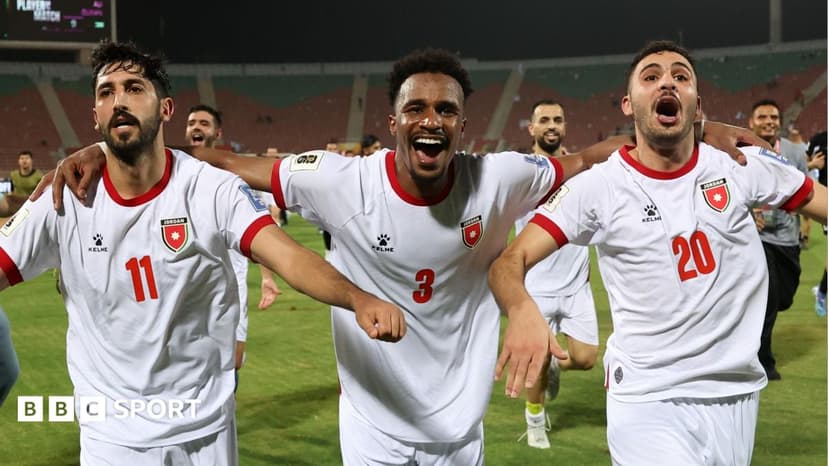
Hours before kick-off, a blue wave had already swept through the stands at Houston Stadium, with thousands of Curaçao fans travelling to witness their nation’s historic debut.
They came from different generations and walks of life, but in Houston they stood together as one Curaçaoan family. For them, Curaçao was not just the smallest nation ever to appear at a World Cup. It was one family – and its flag flew proudly before, during and after their opening 7-1 defeat by Germany.
Among them were siblings Mirella and Rignald Facunda, both in their 70s. Their father had passed down a love of football, and now they stood side-by-side on a day neither would ever forget.
“I’m 70 years old and never imagined I would be at a World Cup,” Mirella said. “But I went to every match. We are a people of faith; we believe in God and we go all the way. The fact that we are even here makes it feel like we’re winning.”
She also pointed to the role her father had played in shaping that sense of unity. “The best thing he did was pass that love of football on to us,” she added. “He grew up with that sense of togetherness, and he raised us to feel it too – not only as brothers and sisters, but as part of the whole island.”
The siblings had also been together on the night Curaçao sealed World Cup qualification – a hard-fought 0-0 draw with Jamaica in Kingston that Rignald will never forget.
“The Jamaica match is the one I’ll always remember fondly,” he said. “We needed a draw but, right at the end, the referee pointed to the spot. We all started praying. Then the VAR checked it and – by the finest of margins – it wasn’t a penalty. The score remained all even, so we qualified.”
That sense of family was not confined to the Curaçao stands – it extended all the way to the pitch, where brothers Leandro and Juninho Bacuna both started for Dick Advocaat’s side. In the aftermath of the heavy defeat, Juninho reflected on what it meant to share such an occasion with his older brother.
“We’ve represented Curaçao together for seven years, but sharing a stage like this with him feels incredible. It’s so special for the family that this dream has come true. The result wasn’t good, but I’m happy I got to experience this with him.”
Blue Wave fan Virgil Ijenia, who arrived at the match with his father, Elder, tried to put that same feeling into words.
“I don’t know, man. It’s so emotional – I couldn’t even sleep. I kept waking up every ten or 20 minutes,” he admitted. “It’s a pleasure to be here – a blessing, in fact. We’re a small island, but we’ve got a big heart.”
Gilmer Belioso, who travelled to the United States with his girlfriend’s family to support the Blue Wave, explained what Curaçao’s World Cup appearance could mean for the next branches of a family tree that stretches far beyond the Caribbean island.
“This is a great way to show the next generation what we can achieve together, and why they have to believe in themselves and each other,” he said. “Everyone on the island is delighted that we are part of the World Cup.”
He also reflected on how Curaçao fans used to get behind other teams at previous tournaments, just to feel part of the occasion.
“It’s crazy to think we used to support other teams at the World Cup – such as Brazil, the Netherlands, Argentina – and now we could be playing against them. It’s a crazy feeling.”
Family also runs through the Curaçao squad in a more literal sense. Beyond the Bacuna brothers, many players were born away from the island but inherited their connection to Curaçao through their parents.
Livano Comenencia is one such example. The scorer of Curaçao’s first-ever World Cup goal was born in Breda, the Netherlands, and wears the Curaçao shirt as another proud member of this extended family. That family spirit will drive Comenencia and Curaçao as they look to bounce back and continue their historic journey.
“We are just one family,” he said. “Not only our group – the whole country is one big family. And family never let you down.”
Sources: FIFA Official