A cursory look at the official stats for points to Sunday's bringing together the best attack against the best defence. Title-holders have scored the most goals while challengers have conceded the fewest. However, sifting through the , the picture that emerges is of a far more nuanced and balanced contest between the respective champions of Europe and South America.
One name that figures large among all the number-crunching is Lionel Messi, the player with both the , eight, and the joint-second-most assists, four. Argentina’s little maestro continues to confound defences as well as Father Time here in North America and he has authored the most goal attempts (34) of any player, the joint-most on target (19), and the highest individual xG (6.16). Oh, and he has taken the most corners too (34).
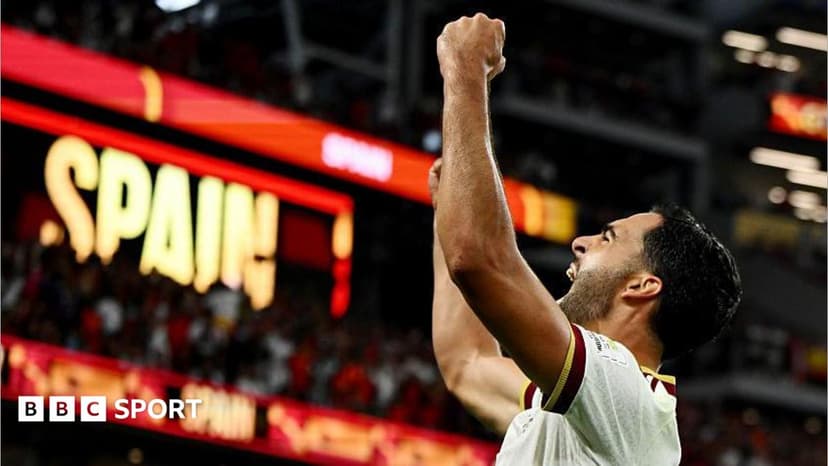
By contrast, Spain can point to a more collective effort in keeping with their progress at this World Cup. Their leading performer in the goalscoring stakes is Mikel Oyarzabal with five goals, while Dani Olmo and Marc Cucurella have each contributed two assists. Oyarzabal slightly edges Lamine Yamal (11-10) in attempts on target.
For stylistic reasons, it should be no surprise that La Roja have the top three players to have attempted the most passes in Rodri (694), Aymeric Laporte (568) and Pau Cubarsi (566), with the next two coming from Argentina – Leandro Paredes (521) and Enzo Fernandez (483).
The same quintet occupy the same order for passes completed, with Rodri boasting an unparalleled 648. It’s a more crowded field when it comes to passing accuracy, where Cubarsi’s 97% and Cristian Romero’s 97% are headline figures.
The statistical evidence also highlights the crucial work off the ball by Oyarzabal and Pedri on the Spanish side, and Fernandez in the Argentinian ranks, as this trio rate first, third and sixth overall for forced turnovers with 53, 48 and 43 respectively.
The quickest speed recorded by any player eligible for Sunday's final is the 35.2 km/h achieved by Argentina’s Giuliano Simeone. However, it’s that man Rodri who has compiled the most high-intensity runs (919) of any World Cup 2026 player, and Spain full-back Cucurella the most sprints of any finalist (304) – with Fernandez (294) not far behind in the latter category. There is no available index for speed of thought … but no prizes for guessing the market leader.
Rodri and Fernandez also show up well in terms of movement, ranking second and fifth for offers to receive (with 389 and 342 respectively). Rodri (232) is joined by Argentina duo Alexis Mac Allister (182) and Messi (179) in the top five for receptions under pressure, meanwhile, and Spain’s Yamal (27) and Argentina’s Nico Gonzalez (23) are the front two for receptions in behind. More generally, it may not be the passing carousel of Spain's tiki taka heyday, but expect plenty of movement nevertheless.
Meanwhile, it’s not for nothing that Spain have kept six clean sheets at these finals in North America. Unai Simon has registered 14 saves, among 108 key interventions inside his penalty area and 84 outside. Opposite number Emiliano Martinez’s equivalent numbers are nine, 87 and 73.
One particularly eye-catching team stat ahead of Sunday’s final is that the side with the most expected goals – with the highest-ranking xG of 15.38 – is Argentina. Time will tell how instructive this proves to be, though it follows that La Albiceleste also have the most actual goals with 19 scored across their seven matches, which of course includes Messi’s significant share.
Spain hardly pale in comparison because they hold second place overall in the former metric with an xG of 14.96 and Luis de la Fuente’s team have also had the joint-most goal attempts with 120 – seven more than their opponents at the New York/New Jersey Stadium. Five of La Roja’s 13 goals have come from Oyarzabal.
Spain have arguably needed fewer goals to eke out victories thanks to their incredible defensive stat of just one goal conceded in seven games – Belgium’s equaliser in the quarter-final. In contrast, Argentina have shipped seven goals. The Spanish also have the most forced turnovers (343 versus 297 for La Albiceleste), and Argentina the fastest ball-recovery time (106.41 seconds v 80.66 for La Roja).
You might expect Spain to lead the way in the distribution categories given their fame as pass masters, but as a unit Argentina have both made more (4772 v 4592) and completed more (4324 v 4156) passes than their weekend rivals. So the pass completion head-to-head favours Argentina, albeit both sides score the same for passing accuracy: 91%.
Finally, the European title-holders have outperformed their South American counterparts in terms of average speed (6.08km/h v 5.6km/h), high-speed running (8836 v 8119) and sprints (3121 v 2854) … and yet Lionel Scaloni’s men have covered the greater total distance (813,091.41m v 799554.12).
How all this will play out on the pitch remains to be seen in Sunday's mouthwatering final.
Sources: FIFA Official