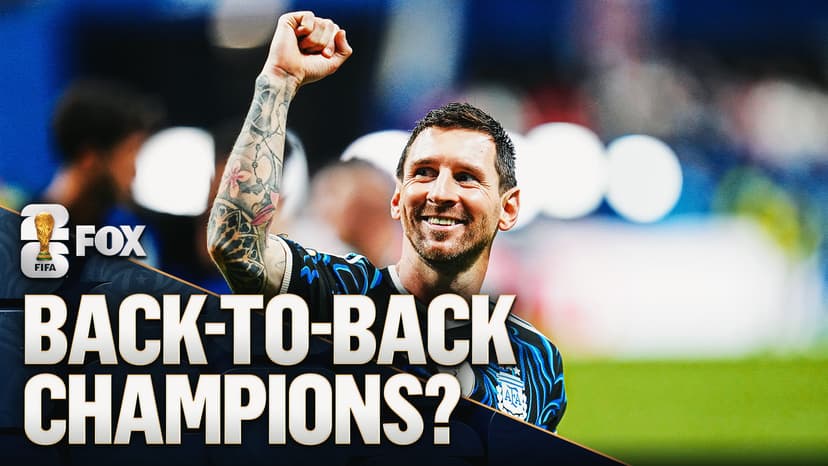
Before making his first-team debut for Barcelona, Lionel Messi was caught between two worlds. In Europe, he was La Masia’s hottest prospect, the teenager everyone was talking about. In Argentina, with the exception of Rosario, where he had played until he was 12, hardly anyone knew who he was.
Argentina had arranged a friendly against Paraguay to tie him down to the Albiceleste, in front of a virtually empty crowd.
On Sunday, at a FIFA World Cup™, with nothing less than his third World Cup Final at stake. But at the 2005 FIFA U-20 World Cup™ in the Netherlands, his story began with an uncertain challenge. More than just a place in the squad, regular game time or a role in Argentina’s next cycle was on the line. More than anything, it was his first real introduction to Argentinian football.
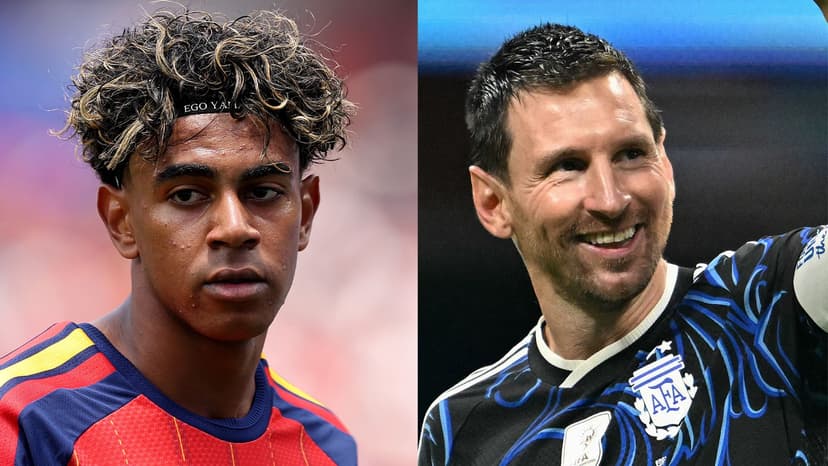
And against Spain, a team that had been closely monitoring his development, he set himself even higher standards. First, he needed to back up the level he had shown since Francisco Ferraro had handed him a starting place from Argentina’s second group-stage match against Egypt. Secondly, he wanted to get the better of rivals and team-mates who were part of his day-to-day life in Spain.
Among Inaki Saez’s Spain squad was Cesc Fabregas, by then plying his trade for Arsenal, having spent several years playing alongside Messi in Barcelona’s 1987 age group. The Spain squad also featured several Espanyol players, among them captain Miquel Robuste and goalkeeper Biel Ribas. Raul Albiol, Fernando Llorente and David Silva were also in the squad, three more youngsters who would go on to enjoy distinguished careers in European football.
“Obviously, Leo knew all the Spanish boys and had a good relationship with Fabregas. We were staying in the same hotel, and he was chomping at the bit to play Spain. Obviously, he wanted to prove that choosing Argentina had been the right decision and that nobody was going to take that dream away from him,” Pablo Zabaleta told FIFA.
Zabaleta captained the side that claimed Argentina’s fifth U-20 world title, adding to triumphs in 1979, 1995, 1997 and 2001, and now serves as a member of FIFA’s Technical Study Group.
For Argentina’s opening match of the tournament against the USA, Ferraro opted to leave Messi on the bench. The Albiceleste were beaten 1-0. Still sporting the No18 shirt and a short haircut, La Pulga entered the fray at the break and transformed the team. From that moment on, he would always be a nailed-on starter.
Argentina lined up in a 4-4-2 formation, with Messi given a free role as a No10, allowing him licence to drift across the attacking line. Argentina played with a balanced double pivot, with Juan Manuel Torres providing the ball-winning and positional discipline between the centre-backs, while Fernando Gago was freed up and allowed to orchestrate play. On the right, Zabaleta was the team’s safety net and leader, while Nery Cardozo, a lightning-fast player who had made his Boca Juniors debut under Carlos Bianchi, occupied the left flank almost as a winger.
“That team, aside from the obvious fact that we had Messi, was a very mature one. Many of us already had between 20 and 30 first-team appearances under our belts,” Gustavo Oberman said. “Messi still possesses all the qualities he had when he was 18 or 19, but he’s added everything he’s learned along the way. He produced things I’d never seen before and never saw again. To run with the ball at the speed he did, with it glued to his feet, changing his stride length, slowing down and accelerating.”
After the match against Egypt on matchday two, Messi proved not only that he deserved to start, but that the impact he had made set him apart from the rest. Every time he got on the ball, it felt as though he could change the game. La Pulga stood out especially in attacking duels. Despite his diminutive frame, he combined extraordinary power with explosive acceleration, using those qualities to shrug off opponents and create dangerous situations.
Against Spain, Argentina hit back after Alberto Zapater had opened the scoring, with Zabaleta pulling them level from a set piece. Then it was Messi’s turn. First, with a sublime first-time pass to put Oberman through. Then, with a composed finish after a perfect touch inside the box. With Argentina in front, the No18 was crucial in helping them keep the ball and avoid taking risks that could put the result in danger.
“From the last-16 clash against Colombia onwards, he found the net in every game that followed. He was key for us. That was the moment he truly announced himself to the world. He then returned to Barcelona and the club decided to move him straight into the first team,” Zabaleta said. "The U-20 World Cup has always been a stage for players to showcase their talents and demonstrate what they’re capable of. That’s when he started to catch everyone’s eye.”
Spain were much more than a quarter-final opponent. For Messi, they represented the football that had shaped him, the country that had watched him grow up and the team-mates who had shared the journey with him throughout his teenage years. That night in the Netherlands, he showed that his journey with the national team was a way of reconnecting with his roots.
A decision driven by love. A choice that would go on to become an endless list of dreams fulfilled.
Sources: FIFA Official