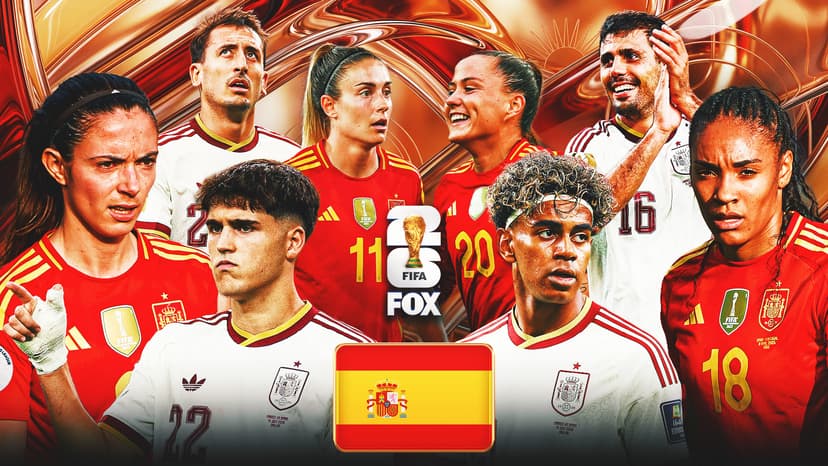
The will pit the contrasting styles of Spain and Argentina, and former Real Madrid team-mates Michel Salgado and Santiago Solari are both confident in their respect nations’ chances of sealing glory.
Salgado played over 50 times for Spain, including at Germany 2006, and believes La Roja’s ability to control the game and their emotions will be vital.
“I know Argentina; they are going to put a lot of pressure on them,” he said on the latest episode of the FIFA Podcast. “They know that they cannot allow us in midfield to control the tempo of the game and to have a lot of space with Rodri and Fabian [Ruiz] and everybody. But I can see the players very, very calm playing. Pau Cubarsi is 19 years old and he can play like he was 38 and he'd played I don't know how many World Cups.
For Salgado, the key to Spain claiming their first title since 2010 is trusting in the collective approach that has seen the reigning European champions establish themselves as one of the forces of the modern game.
“It's not that we have the best players defensively one-on-one, but as a system the way we keep the ball, the way we make the opposition run and run after the ball – it [means] that we defend really, really well as a team. So I'm really positive about this team.
“They don’t need [a] Messi or [an] Mbappe. They play as a team, and they’ve always played as a team. And the team, at the end, wins. And they’re so good [at] playing together. They’ve been playing like this since they were ten years old. That’s the point. They are masters of academic football. They have this methodology that goes [throughout] the system, [from the time] they are very little. And in that sense, Spain is the best in the world.”
Solari, meanwhile, highlighted the wider range of experience in La Albiceleste’s ranks as the potential difference maker.
“Argentina, well, it’s a different kind of football — it’s more intuitive,” he said. “We couldn’t be as organised as Spain is. All the players that are playing this World Cup, they play in different leagues around the world. So it’s not that they are like the Spanish players where most of the players have [grown] within that system or play in the Spanish league or bring this quality to other countries. We export our players very, very young and they have to adapt. So this is one of the strengths. Individually adapt — we adapt and we overcome adversity.
“I think nobody is better than Argentina at overcoming adversity. So, this is one of the strengths. And then we have very, very good football players as well. Technical. Maybe the collective technique is not as good as Spain, but the individual technique is very, very high. Not only [Lionel] Messi. I mean, we have very good midfielders.”
Sunday’s showpiece will be played in in New York New Jersey, where Solari spent a period playing college football in 1994. The Rosario native won the FIFA Intercontinental Cup™ as a Real player in 2002 and then led the club to glory as head coach at the 2018 FIFA Club World Cup™, and was full of praise for the job Lionel Scaloni has done in guiding Argentina to consecutive World Cup finals.
“You’ve got to give him credit because the coach first created a human group, and then he focused on the tactical or on the strategic approach,” the current Real director of professional football said. “And this worked very well for Argentina.”
Naturally, the conversation also turned to the decisive abilities of a player born in Argentina but raised in the Spanish academy system.
“We need to defend [against] Messi as a group and actually [try] to have the ball, to not allow Argentina to get the ball into Messi,” Salgado said. “The problem with Messi is that you can have a look at him and he’s resting in there [for] ten minutes, and he is so intelligent that he will go into the space where he can damage the opposition in just one minute – because it’s not about the quality he has, it's about the football brain, the football intelligence that he has.”
Solari is hopeful that the 39-year-old’s phenomenal individual gifts can settle the contest in Argentina’s favour.
“During this World Cup, all the stars have shone very brightly. [Kylian] Mbappe did, [Jude] Bellingham did, [Harry] Kane did. [Erling] Haaland scored many, many goals. So I think in some way, it was a footballer’s World Cup, it wasn’t a coach’s World Cup. It was the stars who shone.”
The FIFA Podcast takes fans to the heart of FIFA World Cup 2026™ with exclusive access, expert analysis and unforgettable stories from across Canada, Mexico and USA. Hosted by Olivia Buzaglo and Cristian Vieri, the show features FIFA legends, current football stars and celebrity guests reflecting on the tournament’s biggest moments. From match reactions and behind-the-scenes insights to unique World Cup memories, each episode offers a fresh perspective on the beautiful game. .
Sources: FIFA Official