The Match
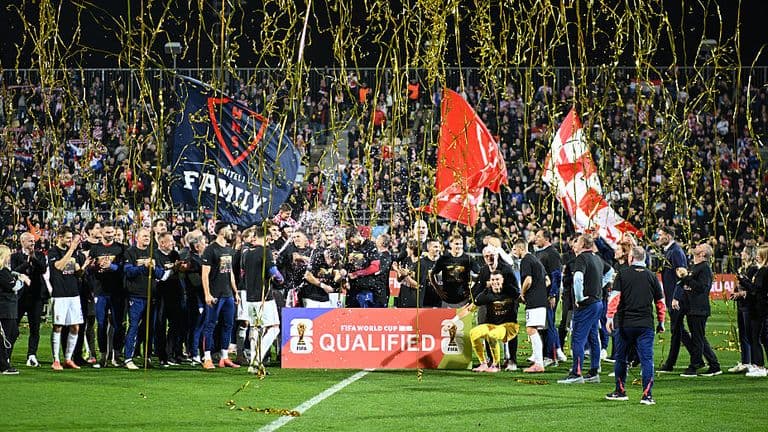
Croatia arrived at AT&T Stadium in Arlington with the experience of 2018 finalists and 2022 semi-finalists, the guile of Luka Modrić still orchestrating from midfield at 40 years of age, and a squad that, while not possessing the individual starpower of some opponents, had the collective intelligence and competitive mentality to make any team uncomfortable. They showed exactly those qualities for long stretches of a pulsating first half against England on June 17, twice fighting back to equalise — through Martin Baturina's 36th-minute strike and Petar Musa's goal in first-half stoppage time — and entering the break at 2-2 with the momentum seemingly on their side. England's second-half performance was, however, of a different quality entirely, and two goals in 38 second-half minutes — Bellingham in the 47th, Rashford in the 85th — left Croatia with a 4-2 defeat that puts their World Cup 2026 ambitions under immediate and serious pressure.
Croatia's opening defensive shape was designed to absorb England's early pressure and counter through Modrić's distribution and the forward movement of Musa. The plan was disrupted by Kane's penalty, recovered by Baturina's equaliser, disrupted again by Kane's second, and then recovered — seemingly — by Musa's stoppage-time strike. In those two hours between England's first goal and the half-time whistle, Croatia had shown enough to believe in their ability to manage the second half. What came instead was Bellingham's swerving drive into the far corner barely two minutes after the restart, a goal that reset the psychological dynamic entirely and from which Croatia, for all their experience and character, could not recover.
Standout Performers
Luka Modrić, at 40 years of age appearing in what is almost certainly his final World Cup, was magnificent as a footballer and a competitor. His ability to control the tempo in central midfield, find passes in tight spaces, and maintain intensity across 90 minutes against opponents who pressed with England's physicality and energy was a reminder that Modrić's technical gifts do not diminish with age the way that pace does. His distribution in the first half, particularly the passes that created both Croatian goals, was the work of a footballer still operating at elite level. He deserved better than a 4-2 defeat.
Petar Musa was Croatia's most energetic attacking threat, pressing England's defenders relentlessly and converting the 45+5-minute goal with the kind of composed finishing that cost Croatia three valuable points last time around. Musa's movement and physicality gave England's central defenders problems throughout, and a Croatia side built around Musa's direct running will be a difficult opponent for the other Group L teams.
Tactical Picture
Croatia's 4-3-3 pressing shape worked well in the first half because Modrić's distribution from deep kept England off-balance and created the transitions that led to both goals. The challenge was England's greater individual quality in the final third — Kane, Bellingham, and Saka are simply better than any Croatia player in those forward areas — which was always going to be decisive over 90 minutes. Zlatko Dalić will consider whether a more conservative second-half approach might have preserved the 2-2 scoreline and given Croatia a point; the attacking ambition that defined their approach cost them dearly when Bellingham struck early in the second half.
Group Implications
Croatia sit on zero points in Group L after the opening round — a position they cannot afford to be in after Match 2. Ghana and England both have three points, meaning Croatia need consecutive wins to qualify, and the character of the 4-2 defeat will need to be processed and addressed quickly. They remain capable of beating Ghana and Panama — the matches likely to decide their fate — but the 4-2 scoreline against England carries a psychological weight that must be managed. Modrić and the experienced core of this squad have overcome worse situations; the question is whether enough of that experience and leadership remains to arrest a potentially critical slide.
One to Watch Next
Luka Modrić is the defining figure in Croatia's World Cup 2026 story — the player whose presence elevates every teammate, whose distribution creates goals from nothing, and whose experience in knockout football may yet prove decisive if Croatia can find their way back into contention. At 40, his physical capacity is clearly reduced from the peak of 2018, but his technical intelligence and tactical understanding are undiminished. If Dalić can organise Croatia around Modrić's strengths and find ways to protect him from the highest pressing intensity, Croatia have enough collective character to recover. Their tournament is not over; it is, however, at a critical crossroads.