The challenge of the 2026 World Cup will extend beyond tactics, pressure and talent - with extreme and dangerous levels of heat presenting itself as a formidable extra opponent.
Researchers have warned that 14 of the 16 venues throughout the tournament will reach dangerous temperatures, one of which will be England's base in Kansas City.
That dangerous level is 28C, and four of those stadiums could reach an even more dangerous 32C in the hottest afternoon hours of the day.
In the southern parts of the US and northern parts of Mexico, temperatures can rise as high as 40C.
An open letter from world-leading scientists has warned FIFA that the current heat safety precautions in place for the World Cup are "inadequate" and could put players, spectators and match officials at serious risk.
FIFA is currently implementing various strategies to manage the conditions effectively, including delaying kick-off times to when temperatures drop, covered stadiums for additional shade, hydration breaks for players and the use of cooling systems in the stadiums.
However, with only Dallas, Houston and Atlanta stadiums equipped with cooling systems - as well as the heat wave during the 2025 Club World Cup offering a worrying insight into what conditions could be like - fears of the impact heat could have on this tournament continue to grow by the day.
World Cup full fixture schedule and KO times
Follow our WC coverage in the Sky Sports app
Here, S ky Sports set out to demonstrate just how severe the conditions players will face could be by replicating the temperatures in both Vancouver and Miami, which will be the hottest location both England and Scotland will play in.
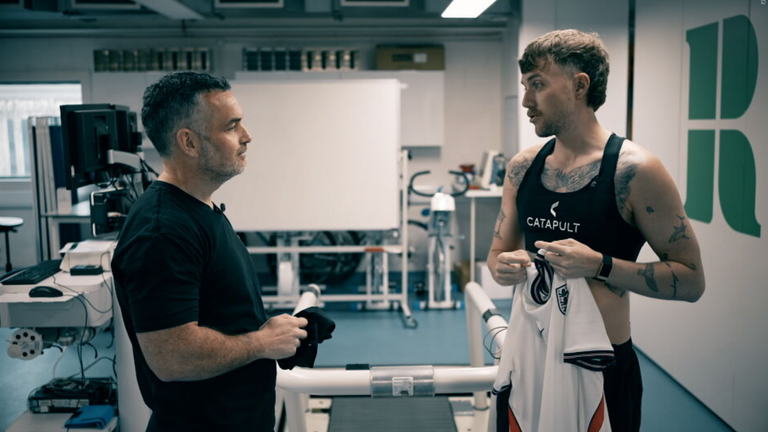
"Sauna-like heat," said Sky Sports News' Roman Kemp when he was tasked with operating in a Miami-like environment while filming at the University of Roehampton climate chamber.
"You do get used to it - but it is hot! The difference is huge, absolutely massive. It will be fascinating to see how tactically it changes the games."
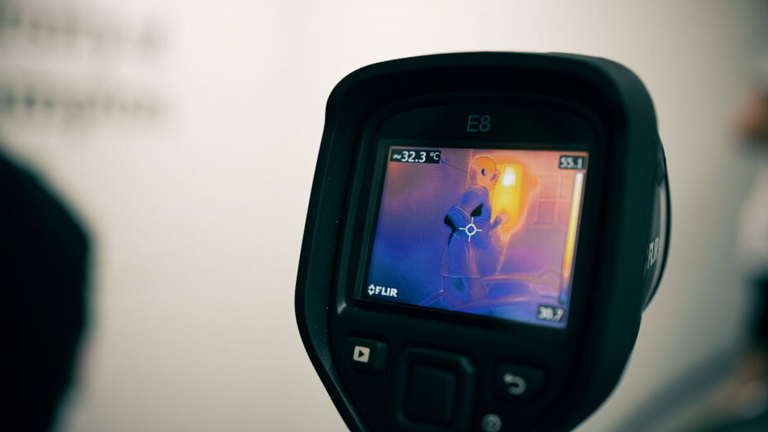
Kemp was first put through his paces on a treadmill in conditions similar to those players will experience when playing in Vancouver this summer.
On an intermittent programme, simulating the stop-start nature of football, he ran for 24 minutes and his body temperature rose 1.1C, which equated to an average rate of 2.78C per hour.
He then replicated the same programme in conditions similar to those of Miami, where his body temperature rose 1.22C, at an average rate of 3.05C per hour.
"The maximum heart rate Roman hit was greater in the heat, but we expected that," explained Catapult's Dr Gordon Rennie.
"It was consistently higher throughout. Between bouts, he wasn't returning to those [rest] values so it is the cumulative effect."
Dr Chris Tyler, a reader in Environmental Physiology at the University of Roehampton and a specialist in human responses to extreme hot and cold environments, explained these rises.
Please use Chrome browser for a more accessible video player
He said: "One of the main reasons the heart rate is higher is the blood is going to the skin. If it is not in the heart, it has to beat harder to keep the blood pumping.
"When the players have their cooling breaks, they will be trying to get the fluids in but also getting their skin temperature down as quickly as possible. Ice vests and ice collars, anything to make them feel cooler."
The charts below illustrate how heat has impacted sprinting and distance covered in the Premier League since the start of the 2020/21 season.
Less running and at lower levels of intensity. Volume and velocity aren't the only impacts heat will have, though, with research suggesting heat also has a noticeable impact on cognitive performance and decision-making.
Tyler also offered his expertise on how teams should be preparing as well as how the heat might impact games from a tactical point of view, where he added: "As soon as the season finished, players should have started doing active heat acclimation," he told Sky Sports .
"England are going to be based in Kansas, which is going to be warm, so they can do some natural acclimatisation there, but it's about making sure they get exposed to that temperature progressively.
"Players will get some adaptations after about five sessions in an environmental chamber, but they won't be fully adapted even after 20. More is more.
"Some of these players will have some previous adaptation from previous hot tournaments, so they might re-acclimatise a bit quicker than some others and some countries with players that are routinely exposed to high temperatures will be naturally adapted to the heat, so they might need less to top it up.
"Player profiles, using technology like that provided by Catapult, allow you to see who is more heat-tolerant, who is more heat-intolerant.
"But this is if they were not conscious human beings. They will change how they play; they will keep hold of the ball, slow things down. It's the more explosive players that don't have more in their locker that might really struggle.
"If you're only an explosive winger, you might struggle, whereas if you're a creative, slower ball player - Andrea Pirlo, for example - if would have less of an effect."
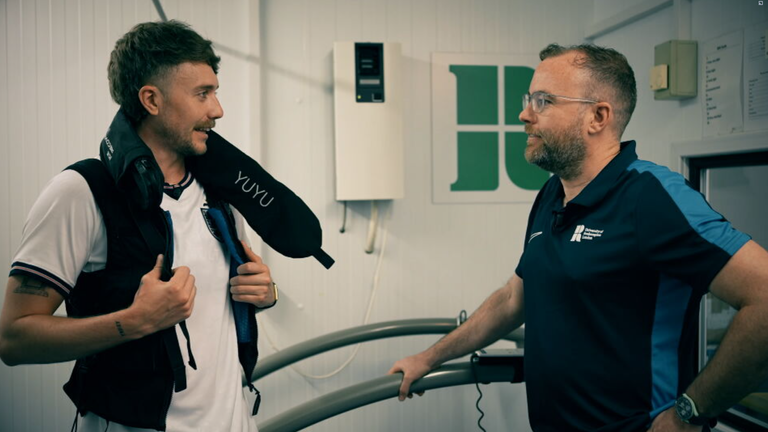
Like Tyler advised, England's preparations for the intense temperatures at the tournament have been well under way for more than 12 months.
Last June, the FA built specialist heat chambers, similar to the one used in Sky Sports' demonstration, in a bid to begin the acclimatisation process for players within the squad.
Players were then asked to swallow biometric tablets so that FA specialists could monitor their internal temperatures and other key data as they exercised in the extreme conditions. Each player was then ranked in terms of how they recovered.
"The conditions are not our biggest enemy but it is not to our advantage after a long and very demanding season for our players," Tuchel said.
"We are not used to being in this kind of heat and humidity, and even altitude if we play in Mexico. There will be a lot of challenges in this World Cup. The heat is one of them but we are prepared already.
"We know the individual reaction of the players to the heat and we have cooling strategies in place.
"We've had help from Team GB and specialists all over the world to come up with solutions that help the players to adapt.
"We know exactly the amount of time we want to expose them in pre-camp, the ideal amount of time that you should train in the sun and that we also don't do too much."
Exposure to high temperatures for prolonged amounts of time can lead to dehydration, heat stroke, cramps, weakness and dizziness.
FIFA says it is "committed to protecting the health and safety of players, referees, fans, volunteers and staff" and that climate risks have been accounted for in their planning.
Three-minute hydration breaks will be utilised in the 22nd and 67th minute of each fixture, regardless of the weather, stadium or country the game is being played in.
There are climate-controlled benches for technical staff and substitutes at every outdoor fixture. Those attending the game as spectators will be permitted to bring factory-sealed bottles into the stadiums, where additional cooling measures will also be used, such as misting systems and extra water distribution.
FIFA will also use Wet Bulb Globe Temperature (WBGT) for heat measurement to consistently monitor the conditions and the levels of stress on the body for athletes.
WBGT stands for Wet Bulb Globe Temperature and is a measurement of heat stress on the human body. It is considered more useful than ordinary air temperature when assessing how dangerous it is for people to operate outdoors.
The federation has claimed games in the hottest parts of the day have been "strategically limited" but at least five games are expected to be played in a WGBT value of 28C, a level that the global union for professional football players, FIFPRO, considers to be unsafe.
Official FIFA regulations state that postponement can only be considered at levels above 32C, although conditions will be monitored and addressed when necessary.
New research reveals that England has been handed a hidden World Cup advantage, as other nations face dramatically tougher heat and altitude conditions than England.
Dr Chris Tyler and his team - who analysed every group-stage fixture - found France, Uruguay, and Czechia are likely to face the heaviest combined environmental burden, and England avoids the most severe heat-and-altitude exposure.

"If you've got three hot games, that could be a problem, but you can prepare for it. If you've got three high games, it could be a problem, but you can prepare for it," he says.
"But if you've got one hot game, one high game, one cool game, you need to try and prepare for the altitude and the heat, without compromising your performance in the other two environments.
"We have mapped out who has the most thermally stressful draw, who has the easiest draw. Portugal, for example, are the only team in their group not playing at altitude, so not only are they the top seeds in their group, they probably have the easiest draw."

Sign up for Sky Sports push notifications Upgrade to Sky Sports to watch every minute of end of season X Facebook TikTok Instagram YouTube WhatsApp Partners Sky Bet Super 6 TEAMtalk.com Football365.com Sky Sports Channels Sky Sports Main Event Sky Sports Premier League Sky Sports Football Sky Sports Cricket Sky Sports Golf Sky Sports F1 Sky Sports Tennis Sky Sports Action Sky Sports News Sky Sports+ Sky Sports Racing Sky Sports Mix More Sky Sites Sky.com Sky News Sky Go Sky Group Sky For Businesses Sky Partnerships Sky Impact Store Locator Advertise With Us Terms & Conditions Privacy & Cookies Notice Privacy Options Accessibility Information Contact Us © 2026 Sky UK

Sources: Sky Sports