Inherent to the knockout stages is that a nation’s campaign can come to an abrupt end. Emotional farewells are said immediately or postponed – you never know ahead of time. France may advance deep into the tournament but Didier Deschamps has written the end of the story himself, announcing in January that he would be
He knows every match could now be his last. Known for his tenacity, he will give it his all to see France lift the trophy once again, even if his legacy has already been cemented into French and, for that matter, FIFA World Cup™ history. The announcement of Deschamps’ departure prompted a heartfelt response from one man who knows him well: Aime Jacquet, who entrusted him with the captain’s armband and guided Les Bleus to World Cup glory in 1998.
In an interview with French radio station France Inter before the start of the 2026 edition, he said: “The French national team is part of your identity. We all know that no one is irreplaceable, but what a journey he’s taken us on! Life goes on, football goes on, and a shiny star is up for grabs this summer. I know you’ve got your eye on it. Good luck, old friend."
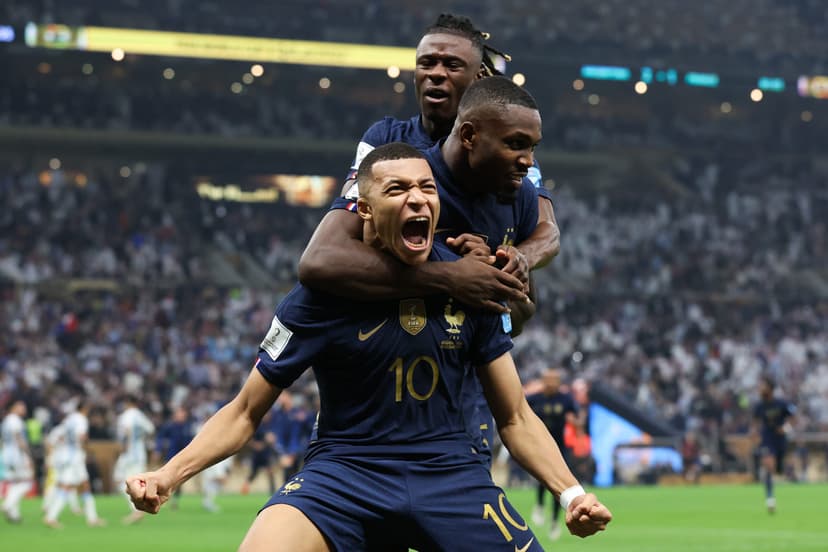
For France, 12 June 1998 was a watershed moment, there was clearly a before and an after. On that day, Deschamps made his first appearance at a World Cup. As captain, he led France to a 3-0 victory over South Africa in their 1998 opener. The French went on to defeat Brazil by the same scoreline a few weeks later in the final, helping France win their first-ever gold star.
Before Deschamps started his World Cup career, France had played 34 World Cup matches across nine tournament appearances, recording only 15 victories. They had reached the semi-finals three times but had never reached the final, settling instead for two third-place finishes – in 1958 and 1986.
The “Deschamps generation” changed the face of French football. Turning France, a perennial outsider, into one of international football’s most formidable teams. Now, before the Morocco v. France quarter-final, the picture looks very different, with 78 World Cup matches under their belt across 17 appearances, 44 victories and two World Cup titles.
That talent for building a winning team is one of the qualities Arsene Wenger admires about Deschamps. “For me, a leader is someone who helps others become better than they would normally be, not someone who imposes or uses force; they are someone who energises others and brings out the greatness within them – greatness they may not even know they possess,” the former Arsenal manager told France Info.
Having hung up his boots in 2000, Deschamps was not part of France’s disappointing World Cup campaigns in 2002 and 2010, when the team exited after the group stage without a single win, or their 2006 run to the final. The Bayonne native returned to the national team set-up in 2014, but this time in the dugout. He has been at the helm of the team ever since.
Under his leadership, France have now reached the quarter-finals of four consecutive World Cups – previously accomplished only by the Soviet Union, Brazil and Germany.
Deschamps’ statistics are staggering. In 24 World Cup matches as France coach, he has recorded 19 wins, three draws and just two defeats. Adding the seven World Cup matches he played as a player (six wins and one draw), the 57-year-old has been directly involved in 31 of France’s 78 World Cup matches. More impressive still is the fact that Deschamps has been either on the pitch or on the bench for 56.8 per cent of France’s World Cup victories.
For Thierry Henry, this success is no accident. “I think I mentioned it in one of the shows when people were talking about luck: it’s not luck. This guy is a serial winner. And that’s about it. I can also tell you how hard it is to have a lot of alphas and make sure that only one will be the alpha,” the former France striker explained on FOX Sports.
Deschamps’ influence however extends far beyond his statistics. Before him, France had never won a World Cup; they have now won two titles. Once overshadowed by football’s traditional giants, Les Bleus now boast nine World Cup quarter-final appearances, more than Italy and Spain, who have seven each, and only one fewer than Argentina.
Under Deschamps, France has now joined the exclusive group of teams to have scored at least 150 World Cup goals; it’s a group composed of only three other teams: Brazil with 246, Germany with 243 and Argentina with 163.
There may yet be another chapter to write. A victory over Morocco and qualification for the semi-finals would mean France would equal Italy’s total of 45 World Cup wins. Before the Deschamps era, the Azzurri were comfortably ahead of France in that category, with 35 wins to 19. A semi-final triumph would also mean France are one step closer to adding a third star to their shirt.
Before the tournament, France captain Kylian Mbappe told media outlet M6: “The best way to pay tribute to him is to win [the tournament], because he loves winning. So we’re going to do everything we can to make sure he has the best possible World Cup.”
Even if France’s journey were to end against Morocco, it would do little to diminish Deschamps’ legacy. Beyond the trophies and records, perhaps his greatest achievement is that he has permanently established France among the best teams in FIFA World Cup history.
Sources: FIFA Official