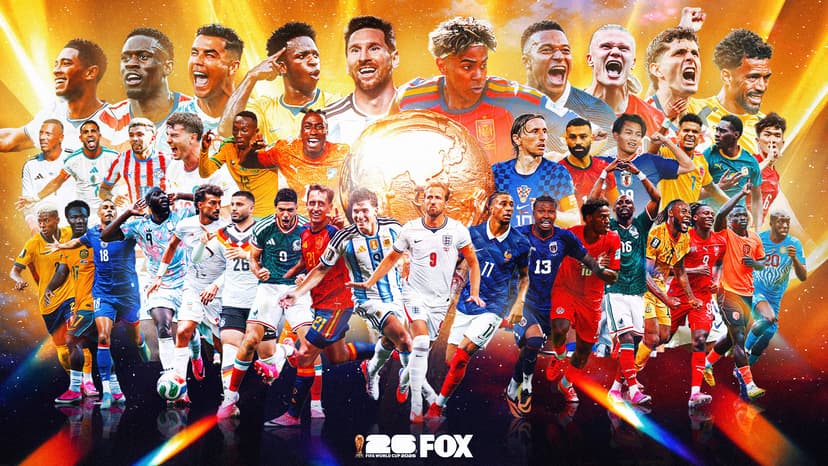
The FIFA World Cup 2026™ is now part of football history, and the tournament that crowned Spain as world champions for a second time will be remembered for a host of remarkable numbers that have seen this year’s edition cement its place among the competition's classics.
The headline statistic is the average goals per game. With 308 goals scored across 104 matches, the tournament averaged 2.96 goals per game. That is the highest figure since 1970 (2.97), comfortably surpassing the averages recorded at Qatar 2022 (2.69), Russia 2018 (2.64) and Brazil 2014 (2.67).
The highest scoring average in FIFA World Cup™ history remains Switzerland 1954, which produced a remarkable 5.38 goals per match. At the other end of the scale are Italy 1990 (2.21), South Africa 2010 (2.27) and Germany 2006 (2.30).
Goalscorers enjoyed the first 48-team tournament, producing the highest number of goals ever. In the 96 years since Uruguay 1930, never before had so many players scored six or more goals at a single tournament.
Six players reached that milestone: Kylian Mbappe finished as the tournament's leading scorer with ten goals, followed by Lionel Messi (eight), Jude Bellingham (seven), Erling Haaland (seven), Ousmane Dembele (six) and Harry Kane (six).
Mbappe also became the first player to finish as the tournament's top scorer at two FIFA World Cups, having claimed the adidas Golden Boot at the FIFA World Cup Qatar 2022™ with eight goals.
The Frenchman also became the first player since Gerd Muller in 1970 to score ten goals in a single edition. Only Just Fontaine (13 in 1958 for France) and Sandor Kocsis (11 in 1954 for Hungary) have ever managed a higher tally.
The 2026 showpiece also served as a stage for Lionel Messi and Kylian Mbappe's duel for the all-time World Cup goalscoring record. Messi arrived at the tournament on 13 goals, with the Frenchman just one behind on 12. The record of 16 belonged to Miroslav Klose. Messi equalled Klose’s record in Argentina's opening match, scoring a hat-trick in a 3-0 victory over Algeria. He struck twice more against Austria in the second group game to move clear at the top on 18 goals. Argentina’s No10 then continued his goalscoring form against Jordan, Cabo Verde and Egypt to take his tally to 21. Mbappe, however, remained on his tail. The race reached its dramatic conclusion in the bronze final, when the French forward scored twice in France's 6-4 defeat to England. Despite ending up on the losing side, he finished the tournament with 22 FIFA World Cup goals, becoming the competition's all-time leading scorer.
As has become increasingly common in elite football, set pieces once again proved a major source of goals at the 2026 tournament. A total of 38 goals came from corners, free kicks or long throw-ins. Overall, 54 of the tournament's 308 goals came from set-piece, including 16 penalties, accounting for 17.5 per cent of all goals scored.
Shooting from distance also proved an increasingly effective way to unlock stubborn defences. Forty-three goals came from outside the penalty area – seven direct free kicks and 36 from open play. That represents 14.6 per cent of all goals scored across the United States, Mexico and Canada. By comparison, only 8 per cent of the goals at Qatar 22 came from outside the box. The figures suggest a growing trend as teams look for alternative ways to break down compact defensive blocks. "When there isn't any space – when eight or nine players are in or around the penalty area – then long-range shooting becomes an ideal solution," said Jurgen Klinsmann, a member of FIFA's Technical Study Group (TSG).
Delivering the ball into the box from wide areas – whether through aerial crosses or low deliveries – continued to be one of the most productive routes to goal. A total of 75 goals came from crossing situations, including the strike that clinched the final for Spain. Several of the tournament's other decisive moments also came from crosses, including Lautaro Martinez's winner that sent Argentina into the final, Erling Haaland's opener against Brazil and Enzo Fernandez's goal that completed Argentina's comeback against Egypt. Crosses accounted for 24 per cent of all goals scored throughout the tournament – almost one in four. This figure excludes goals scored directly from set-piece deliveries such as corners, long throw-ins and crossed free kicks.
In terms of clubs, Real Madrid finished comfortably clear at the top of the goalscoring standings. Players representing the Spanish giants scored 22 goals between them: ten from Kylian Mbappe, seven from Jude Bellingham, four from Vinicius Junior and one from Arda Guler. Paris Saint-Germain came second with 15 goals, while Arsenal FC completed the podium on 13. However, it was rival club FC Barcelona's .
The world's richest domestic competition once again underlined its quality. Premier League clubs supplied more goalscorers than any other league at the World Cup. Players from English top-flight clubs scored 79 of the tournament's 308 goals, accounting for 25.6 per cent of the total. Spain's top flight ranked second with 41 goals, followed by Germany (25), France (23) and Italy (22).
Sources: FIFA Official