Fifa’s embrace of rapacious American capitalism may have found its limits in Miami, one of the entertainment capitals of the world.
Despite just seven tickets showing as available on their official website at kick-off there were thousands of empty seats – and empty concourses – throughout most of this game, a hard-fought draw which leaves Group H deadlocked following Cape Verde’s stunning draw with Spain earlier in the day.
Read more Gianni Infantino has famously attempted to portray the World Cup as 104 Super Bowls, although judging by this turnout the locals require some convincing. While the official attendance was given as 62,764 out of a capacity of 64,478, many did not turn up until the second half, with Fifa sources claiming that a crash on the highway was responsible for the late arrivals.
Miami has more Instagram influencers per capita than Los Angeles and New York, which suggests that Fifa should have recruited some of them to help shift tickets rather than the ubiquitous IShowSpeed, whose hyperactivity has begun to irritate some A-list guests in Fifa’s VVIP areas.
As their city is built on celebrity and glamour Miami residents are not easily impressed, and even sports fans are spoilt for choice.
The Hard Rock Stadium has hosted six Super Bowls and is a regular staging post on the Formula One circuit, so a group stage World Cup game featuring two goal-shy sides was never going to be a red letter day.
The empty seats also showed the potential pitfalls of Fifa’s reliance on another US staple, the secondary ticketing market, as there is no doubt the tickets were sold.
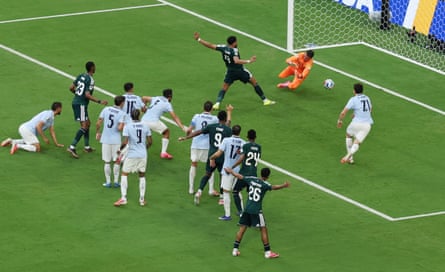
View image in fullscreen Saudi Arabia’s Abdulelah al-Amri pokes home to open the scoring. Photograph: Paul Childs/Reuters Given that the face value of category one and two tickets was $430 and $600 respectively it appears unlikely there were thousands of deliberate no-shows, with a more plausible scenario being that tickets snapped up by speculative opportunists were not sold on.
Uruguay deserved their point after coming from behind, as they controlled for all but the last 10 minutes of the first half when Abdulelah al-Amri gave Saudi Arabia the lead against the run of play.
Uruguay’s preparations for the game had been disrupted by a delay to the flight from Cancún to Fort Lauderdale , in the latest example of the potential pitfalls of staging a multi-country World Cup, but their travel problems did not appear to have had any lasting effect.
As one would expect from a Marcelo Bielsa side they dominated possession from the outset and created a good chance in just the fifth minute, when Federico Vinas’s cross from the left was met by Ronald Araújo, whose shot was saved by goalkeeper Mohammed al-Owais.
There was a polite enquiry for a penalty in the 20th minute when Sebastián Cáceres shot struck the hand of Hassan al-Tambakti, but his arm was clearly by his side and their best chance of the first half fell to Vinas, whose low diving header went straight at Owais.
Cheered on loudly by an impressive showing of fans clad in green, Saudi Arabia hung in the game and got their reward just before half-time.
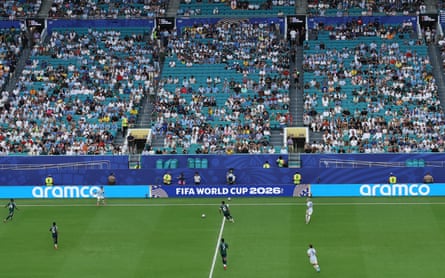
View image in fullscreen Empty seats in the stands as Uruguay and Saudi Arabia battle to a 1-1 draw. Photograph: Paul Childs/Reuters Amri had already brought an excellent save from Fernando Muslera with a powerful header from a corner in the 38th minute before he gave his side the lead from another set-piece three minutes later.
Musab al-Juwayr’s cross was met by a header from Tambakti, which Muslera parried, with Amri quickest to react by tapping into the net. Muslera will have been annoyed that he did not catch the ball cleanly, as was Bielsea judging by his thunderous expression on the sidelines.
Bielsa responded by making two changes at half-time, including removing Darwin Núñez, who even allowing for the hot and humid conditions had looked off the pace throughout.
In fairness to the former Liverpool striker he has only played two matches – both for Uruguay in March – since February, when he was deregistered by Saudi Pro League club Al-Hilal following their signing of Karim Benzema.
Bielsa also moved Federico Valverde to a more central role after he had been largely anonymous wide on the right during the first half, a tactical switch which made a difference as Uruguay’s dominance returned.
Saudi Arabia defended stoically however, and limited their opponents to half-chances from crosses. Vinas and the substitute Agustín Canobbio both headed wide, while Owais made another good save from Manuel Ugarte, whose shot from the right was pushed onto the far post.
Uruguay continued to attack down the flanks, though, and an equaliser that felt inevitable arrived in the 80th minute. Mathías Olivera’s cross was headed towards goal by Vinas, Owais failed to catch the ball, and Maxi Araújo reacting quickest with a neat side-footed finish at the near post.
Owais made amends in injury time however, making two good saves from Nicolás de la Cruz and Valverde.
After dropping two points Spain were the real winners from this result, and will aim to capitalise when they face Saudi Arabia in Atlanta. Uruguay return here to face Cape Verde on Sunday, which will also present another test of Fifa’s sales strategy.
Sources: The Guardian