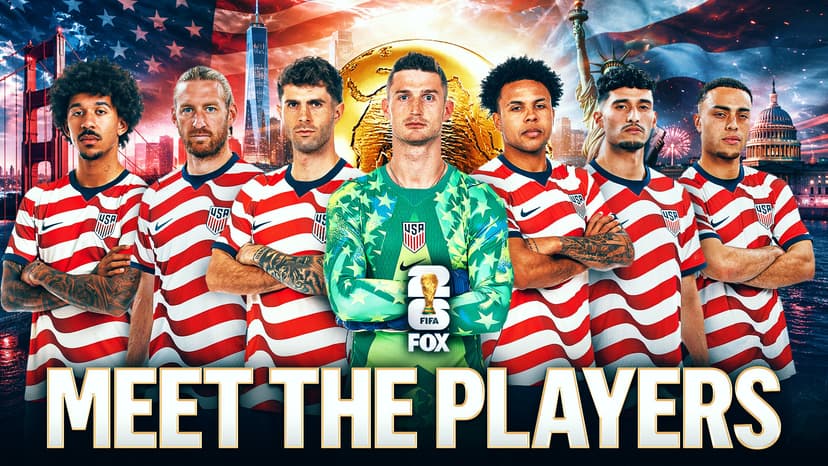
The will be the experience of a lifetime for the USA players appearing on home soil, much like the sensation felt by the legendary 1994 team. But for the few who narrowly miss out on selection, the matches will be painful reminders of what could have been.
It’s what Jeff Agoos went through 32 years ago when he was one of the final cuts. He went on to make the team for France 1998, only to not play a single minute. Fortunately, the former defender's story did not end there. Redemption came at Korea/Japan in 2002, as he started all three group matches before an injury against Poland in the finale ended his tournament.
One would be hard-pressed to find a more resilient figure in USA men’s national team history, and the same character displayed during his playing career is seen in his work as General Manager of the Portland Thorns of the National Women’s Soccer League (NWSL).
Agoos recently visited with FIFA to look back on the lessons learned from 1994 and his message to the players who will suffer the same disappointment.
Jeff Agoos: I’m really looking forward to the World Cup coming here to North America. It's really the first phase of a long pathway of events that are happening in North America, including the 2028 Olympics. We've got the Women's World Cup in Brazil in our hemisphere, then possibly the Women's World Cup coming back here in 2031, so there's just a whole host of opportunities here in North America for soccer.
I'd love to see a game or two, just to be back in that environment. For those people who haven't gone, it is such an incredible opportunity. It's bigger than any other sporting event I've ever gone to. It celebrates diversity. It celebrates different cultures. It celebrates a global game. And for people who haven't been part of it, I think they're just going to have the time of their life.
That's a huge question. I'm really interested to see who will be available, what kind of team they put out. There's nothing easy when you play in the World Cup. Paraguay will be a very challenging game. The first game is the most important game. You've got to try to get maximum points, but I think having it in your home country gives you a certain motivation and boost. I expect good things from the U.S. team.
There are two types of players: The ones that you know are going to be in; they're managing the last part of their season. There's obviously this desire to play your hardest, but also avoid injury. Then you have a second band of players who are on the bubble and desperately trying to do everything they can to convince the national team coach to select them, and that's by having good club performances. They are going a hundred miles an hour with their club team.
I think perseverance and resilience were two of the big learning lessons for me. It was unfortunate that I wasn't selected for the final team, but I would say it was one of the biggest learning opportunities that I've had as a player. As a person, you learn a lot about yourself from failure. You learn a lot about yourself from making mistakes and you either grow or you stay where you are. And I knew it was important to make sure that whatever happened in not getting selected for the team would make me a better person.
Don't let one person's decision define who you are as a player and define who you are as a person. There is opportunity in crisis. There's opportunity in failure. Understand that there's a grieving process you're going to go through because this was such an important part of your life and a hope. But if you're not selected, it's only one person's decision, not who you are and what your value is. Make sure that you look at this and seize the opportunity that's in front of you.
It was the joy of being finally selected for the national team, going to a World Cup, going to France, preparing myself, having played through the qualifiers, only to suffer the heartbreak of not playing in the tournament at all. I think it was another opportunity to really learn about yourself and who you are and what you're about, that resiliency that we talked about before.
I'm getting goosebumps thinking about it now. Just hearing the anthem, the culmination of a life's work of getting to that point, but also, while enjoying the moment, still feeling that there was a job to do and making sure that you could perform at your highest level. That this was ultimately going to be the ultimate test of who you are as a player and as a person, but also to really enjoy the moment and absorb everything that comes along with it.
Yeah, I think fortunately we were able to hold on and win against a team that was a dark horse to win the World Cup, so it was really a proud moment in terms of what we were able to accomplish, but we knew we had more to go. You also have to remember that we were mostly players that were playing in Major League Soccer, so we wanted to represent our country, our domestic league. We wanted to prove that the league had an engine and momentum.
I love all of it. The engagement here with fans is the best I've seen of any club. We're averaging 19-20,000 people per game. Fan engagement and fan affinity here and the connection to the community is fantastic. Our ownership group of Alex and Lisa Bhathal are just incredible people who are investing not only in women's soccer, but in women's sports.
Our goal is to give our players the tools and resources to make sure that they can excel, that they're put in an environment where they're tested every day and that they can grow. If you just look across our entire starting roster, almost every one is an international player. We couldn't be more proud of representing a global game here in Portland.
Sources: FIFA Official